FOR PHDs, POSTDOCS & EARLY-CAREER FACULTY
GET MORE REAL RESEARCH DONE IN 90 MINUTES THAN YOU USED TO IN A FULL DAY

Simo Hosio, Professor of Computer Science and Engineering
Three powerful courses with complementary tools that install a permanent focus-and-habits system for you. Do this once, and your progress never relies on willpower again.
From an academic who's been the drowning postdoc, not a productivity influencer.
Pay once, own forever. 30-day money-back guarantee, keep everything even if you refund.
You're Smart Enough. You're Working Hard Enough. So Why Does It Still Feel Like Drowning?
You open your laptop at 8 AM. By noon, you've answered emails, attended a meeting that didn't really matter much, and stared at your manuscript for 20 minutes without writing a word.
But you know all the latest world news. Which has nothing to do with your work.
Sound familiar?
"I've been feeling like I'm not productive enough... I still feel like I'm wasting time or not moving fast enough."
"Unless I'm constantly working until I'm mentally exhausted, I feel guilty for not doing enough."
"I still show up, but I'm barely functioning. Every week that passes, I feel like I fall further behind."
These aren't made up. These are real words from real academics. If you recognize yourself in any of them, you're not alone. You're stuck in a system that was never designed to help you.
You work all week long and skip normal weekends. You tell yourself you just need more discipline.
But nobody tells you this in grad school:
You don't have a system. That's the problem.
You're running your academic work on scattered advice from Twitter threads, burned-out senior academics, and productivity videos that were designed by tech bros. You've tried all the tips, all the tricks, all the timers. And you're still here.
"I feel like I know all the different systems, tips, tricks, timers... but no matter what I tried... I just didn't want to do the work."
That's what happens when you have tips without the infrastructure to support them.
You don't need another hack. You don't need more willpower. You don't need to "grind harder."
You need an operating system.
Academia Has a System Problem
PhD students experience anxiety multiple times the rate of the general population. The system is broken. And it's been broken for a long time.
The cycle you're stuck in right now:
No clear direction → Work on whatever feels urgent → Can't focus → Panic before deadline → Heroic burst → Burnout → Guilt → Repeat
"Academia is a pie-eating contest where the prize for winning is more pie."
And every time you fail, you blame yourself. "I should be more disciplined." "I should be able to focus." "Everyone else seems fine."
They're not fine. They're just quiet about it.
"Imposter syndrome hits hard when I walk into the office and see other doctoral candidates deeply focused."
"I am scared I am falling behind my peers. Publications, successful experiments, funding success, graduation timeline."
Academic Suffering Culture tells you that pain equals progress. That if you're not exhausted, you're not trying hard enough. That burnout is just "part of the process."
That's a lie. And it's standing between you and the career you actually want.
The academics who seem to have it together? They don't work harder than you. They have better infrastructure. And that infrastructure can be learned, installed, and run like an operating system.
(You'll see exactly how in about 10 minutes of reading.)
Without a System (RIGHT NOW) | With the PhD Power Trio |
|---|---|
Wake up overwhelmed, not sure what to work on | Wake up with a clear plan (daily WOOP takes 2 minutes) |
Work 10+ distracted hours, produce very little | 2-3 hours of deep work that moves things forward |
Deadlines cause panic, heroic last-minute sprints | Work gets done well before deadlines, stress disappears |
Goals are vague wishes ("I should write more") | One magnetic 12-week goal with emotional pull and a system to hit it |
Rely on willpower that always runs out | Automatic habits that deliver progress without thinking |
Blame yourself for not being "disciplined enough" | See it was always a system problem, and now you have one |
No clear way forward | A blueprint to follow starting today |
Don't Take My Word For It
The PhD Power Trio: Your Academic Operating System
Think about your computer. A borderline magical machinery runs quietly in the background, managing everything, making sure your apps work together smoothly.
Now think about your academic life. Where's YOUR operating system?
The PhD Power Trio gives you one. Three systems that work together the way your computer's OS does, running in the background, making everything easier:
Direction → Know exactly what to work on and why
Execution → Actually do the work when you sit down
Automation → Make daily progress effortless
When one system is broken, everything suffers. When all three run together? 1 + 1 + 1 = 4. They compound each other.
Get the Complete Academic OS for $147
Course 1: Direction System (Goals, Time & Experiments)
"You're not lazy. You're running a broken operating system."
Most academics set vague goals like "I should write more" and wonder why nothing changes. This course rewires how you think about direction entirely.
You'll learn:
- The N=1 Protocol. You are the greatest experiment you should be running. Stop copying other people's systems and build your own based on what actually works for YOU
- The Power Audit. Map where your time actually goes with the Eisenhower Matrix for academia. Most people are shocked at how little time they spend on what actually matters
- Three Questions That Create Time. Not "manage" time. Literally create it by eliminating what doesn't serve you
- Magnetic Goals. Goals that PULL you instead of push you. When your goals excite you to wake up, willpower becomes irrelevant
- The SMARTER Goal System. SMART goals turbocharged with emotional juice. Studies show up to 400% increase in daily productivity using this framework
- The MCII Protocol. Mental Contrasting with Implementation Intentions. Your weekly and daily execution blueprint backed by Gabriele Oettingen's behavioral science research
- Daily WOOP. A 2-minute morning ritual (Wish, Outcome, Obstacle, Plan) that sets up every single day as a victory
8 video lessons + exercises + the complete 12-week goal system
After this course, you wake up every morning knowing exactly what to work on and why it matters.
Course 2: Execution System (Mastering Focus)
"The most productive scholars aren't smarter than you. They just focus better. That's literally the only difference."
We live in an attention economy where the smartest engineers on the planet are paid billions to steal your focus. Your phone alone is a MAP disaster (Motivation + Ability + Prompt, all perfectly engineered to distract you).
Focus is a skill you can train. This course shows you how.
You'll learn the Five Factors of Focus:
- Biological. Sleep optimization, Non-Sleep Deep Rest for afternoon resets, working with your natural energy rhythms, the caffeine + L-theanine combo backed by examine.com research
- Psychological. Why journaling is the #1 focus tool (and why pen beats keyboard), 20-minute phoneless walks, visualization techniques that lower the barrier to starting work
- Environmental. The Coffee Shop Effect (why background noise actually boosts focus), workspace design, functional music, nature exposure
- Behavioral. BJ Fogg's B=MAP formula from Stanford, phone management, self-interruption capture, building automatic triggers for focus
- Social. Accountability systems, learning to say no, communicating boundaries upward, asking your boss for permission to disappear and do deep work
7 video lessons + the Focus Radar self-assessment tool + weekly tracking system
After this course, you can sit down and do 2-3 hours of truly focused deep work daily. That's more than most academics get done in a full week of distracted 10-hour days.
Course 3: Automation System (Building Habits That Stick)
"You literally are your habits. Change your habits, change who you are."
This isn't another "21 days to build a habit" course. (That number is a myth. Doesn't exist in the research.) This is a complete behavior engineering system based on BJ Fogg's work at Stanford, reinforcement learning, and identity psychology.
You'll learn:
- The Master Equation (B=MAP). The formula that explains every single behavior in your life. Once you see it, you can't unsee it. And you can use it to install or eliminate any behavior
- The Seven-Step Habit Creation Protocol. A systematic process from terrain audit to identity rewrite to loopcraft to celebration. Zero willpower required
- Golden Behaviors Matrix. Find the ONE habit that's easy enough to stick AND impactful enough to matter. A low-impact habit you do every day beats a high-impact habit you quit after a week
- Habit Stacking. Bundle new habits onto existing ones. "After I [existing action], I will [new tiny action]." This is how a morning coffee became 100 consecutive pushups
- The Gains Journal. Plan three wins every day. Celebrate them every evening. Based on "The Gap and the Gain" by Dan Sullivan. Teaches you to make every day a victory
- Stopping Bad Habits. You can't break them, but you can stop them. Four protocols: remove the trigger, break the chain (5 links), replace the routine, or outgrow them. The garden metaphor: plant flowers instead of pulling weeds
- Top 10 Mistakes in Behavior Change. The capstone that prevents you from falling into the same traps everyone else does
15 video lessons + exercises + the complete habit engineering toolkit
After this course, you make daily progress on papers, grants, and research through boring consistency. No motivation required.
 )
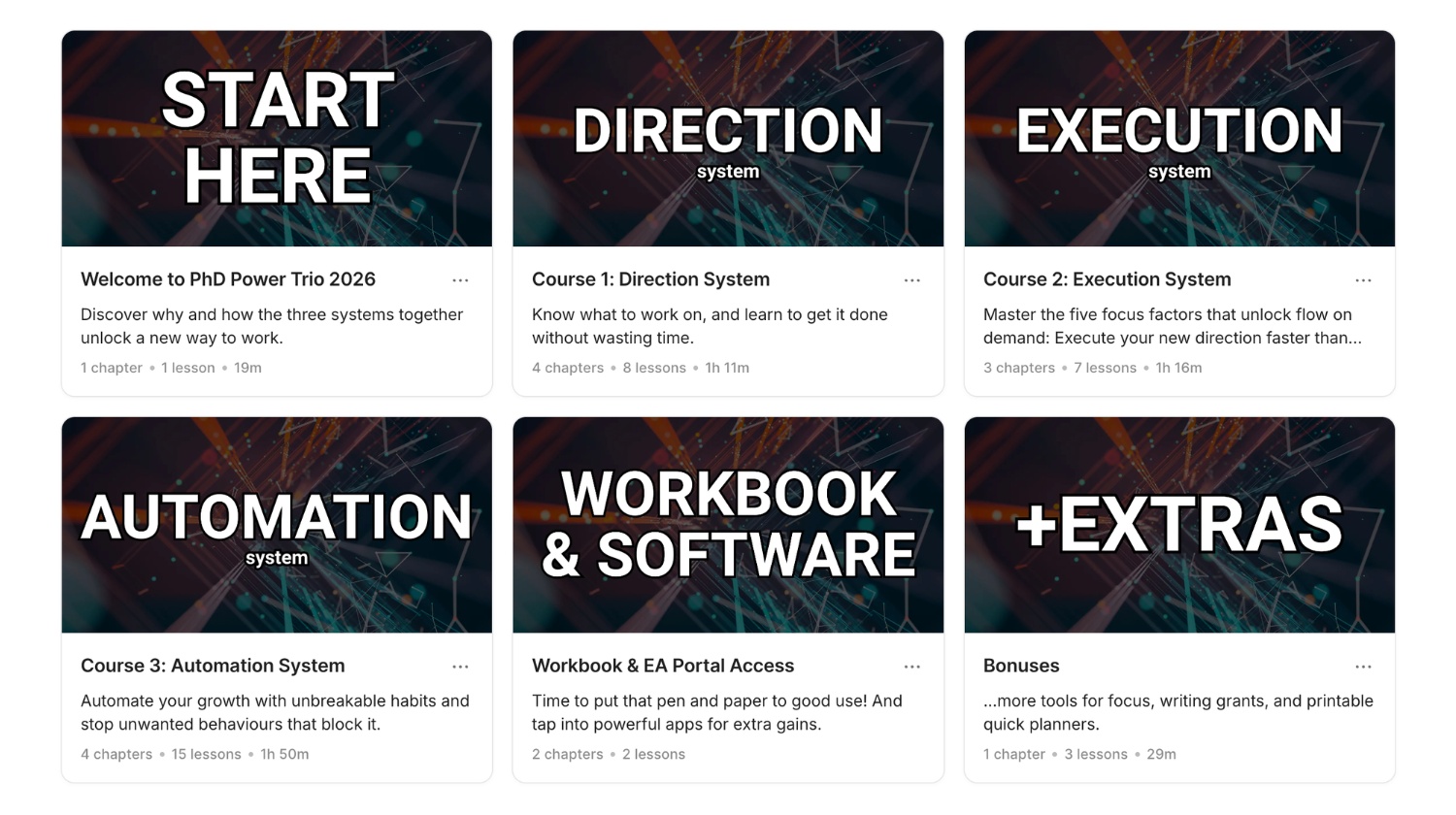
)Discover 30 video lessons, an intro tutorial, a workbook, and access to the Edge Academia Portal (software) in one handy dashboard in our learning management system.
Key Differentiator: The PhD Power Trio Workbook
This is where everything clicks. The workbook walks you through all three systems with pen-and-paper exercises that connect Direction, Execution, and Automation into one integrated operating system.
- The Power Audit exercise (map your time into the four quadrants)
- Your SMARTER goal with full emotional juice
- Your personal Focus Radar baseline
- The Golden Behaviors matrix
- Your identity rewrite
- Weekly and monthly check-in protocols
The courses teach you the systems. The workbook makes you build YOUR version of each one. Because watching videos and building infrastructure are two very different things.
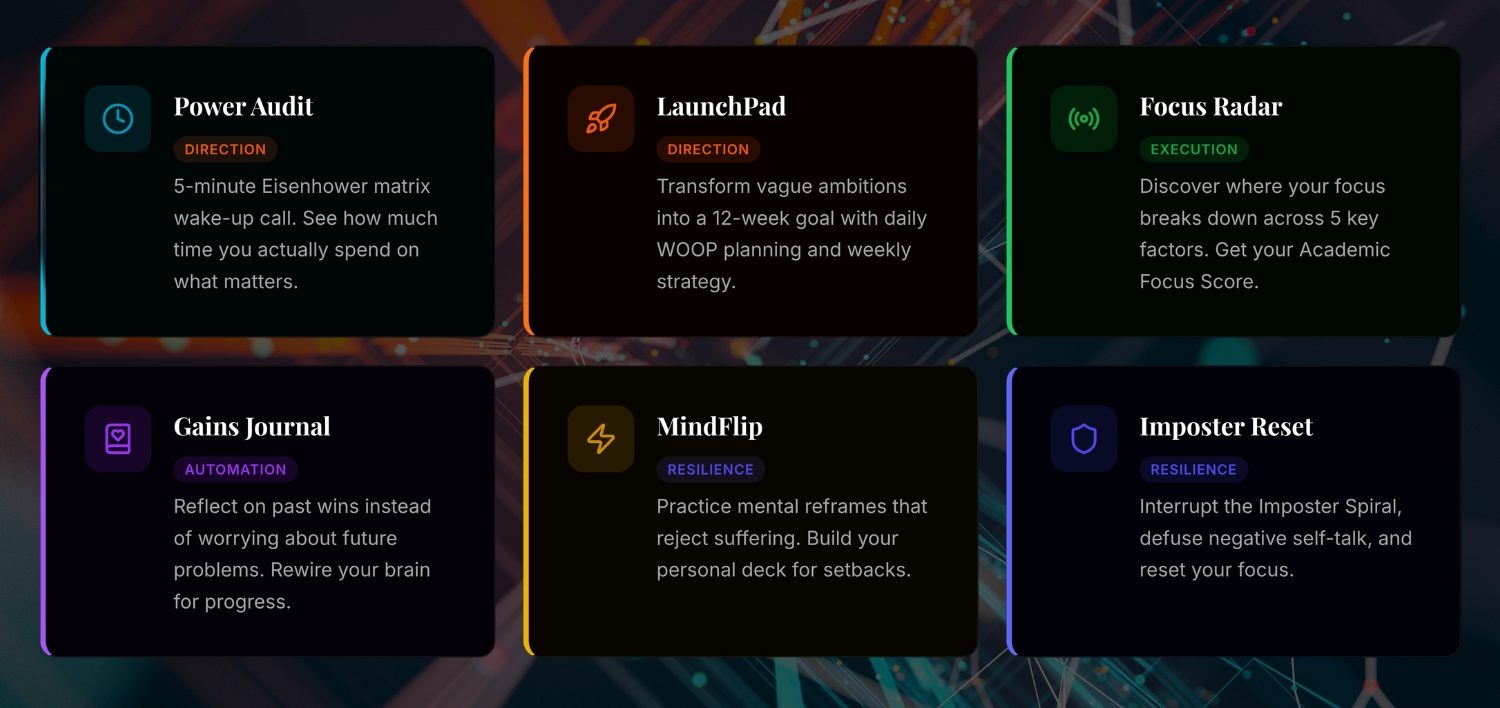
Six Interactive Tools Included. Because a Course Shouldn't End When the Videos Stop.
Most courses give you videos and a PDF. You watch, you nod, and then nothing changes because you don't have the infrastructure to actually run the system.
The PhD Power Trio gives you the system AND the tools to run it.
Already have Edge Pass? The six tools below are yours already, and that's great. PhD Power Trio is the training that makes those tools 10x more powerful. The courses teach the systems and frameworks behind the tools. Once you see them, you'll finally understand *why* each tool exists and *how* to work them day to day. If you've been sitting on Edge Pass without using the tools much yet, this is the piece that is missing right now.
Every tool lives on the Edge Academia Portal. You log in, you use them, they track your progress. The tools are a form of live infrastructure for your academic career.
DIRECTION TOOLS
The Power Audit
Maps directly to Course 1
The Eisenhower Matrix digitized, with a pinch of added magic. Audit where your time actually goes across the four quadrants. See exactly how much time you're spending in "The Zone" (important but not urgent) versus putting out fires. Track your progress over weeks and months.
In the course you'll hear: "Be honest. When I was doing this for the first time, I was really surprised how little I had in the zone."
Now you you've got an interactive tool that does it for you and tracks your improvement.
LaunchPad
Maps directly to the MCII and WOOP protocols
Three planning modes in one tool:
- Sprint Mode. Set your 12-week SMARTER goal with full MCII (barriers + if-then plans)
- Weekly Mode. Your Sunday/Monday weekly planning ritual
- Daily Mode. Your morning WOOP in under 2 minutes (Wish, Outcome, Obstacle, Plan)
Plus AI coaching that helps you refine your goals and troubleshoot when you're stuck. Like having a goal-setting coach on call.
The course teaches the system. LaunchPad runs it.
EXECUTION TOOLS
Focus Radar
Maps directly to Course 2
The Five Factors of Focus (Biological, Psychological, Environmental, Behavioral, Social) as an interactive self-assessment.
- Score yourself across all five dimensions (0-10 scale)
- See your focus profile as a radar chart
- Set goal states and track progress over 1 week, 1 month, 3 months
- Find your weakest link instantly
- Premium self-assessment mode with deeper analysis
The course asks: "If you don't track your focus, how do you know if any of this stuff is working?"
Focus Radar answers that question with data.
AUTOMATION TOOLS
Gains Journal
Maps directly to Course 3
Plan three wins every morning. Celebrate them every evening. Based on the "Gap and the Gain" framework.
This is the tool that turns every day into a victory. When you set up your day to be a win, and then celebrate that win, your self-efficacy compounds. And self-efficacy is one of the strongest predictors of academic productivity, satisfaction, and wellbeing in the research literature.
MindFlip
Spaced repetition for all three courses
A flashcard system with two layers:
- Master Deck. Curated cards covering the key frameworks, formulas, and principles from all three courses, tweaked to train your mind instead of memorizing info
- Personal Deck. Create your own cards from your experiments, insights, and breakthroughs
Spaced repetition keeps the PhD Power Trio concepts alive in your brain long after you finish the videos. Watching a course and internalizing a system are two very different things.
RESILIENCE TOOLS
Imposter Reset Protocol
A guided 5-step protocol for when imposter syndrome hits. Because let's be honest: "Imposter syndrome hits hard when I walk into the office and see other doctoral candidates deeply focused."
This tool walks you through recognition, reframing, and reset. Plus a community feed where you can see that you're not alone (anonymous confessions from other academics going through the same thing).
LET'S PUT A NUMBER TO WHAT YOU'RE GETTING
| What You Get | Value |
|---|---|
| Course 1: Direction System (8 video lessons + workbook) | $197 |
| Course 2: Execution System (7 video lessons + workbook) | $197 |
| Course 3: Automation System (15 video lessons + workbook) | $297 |
| PhD Power Trio Workbook (exercises for all three systems) | $49 |
| Power Audit Tool (interactive Eisenhower time audit) | $29 |
| LaunchPad with AI Coaching + Sprint Pods (goal system + accountability) | $346 |
| Focus Radar (5-factor assessment + progress tracking) | $79 |
| Gains Journal (daily win tracker + celebration system) | $49 |
| MindFlip Flashcards (spaced repetition for all frameworks) | $49 |
| Imposter Reset Protocol (5-step guided reset + community) | $79 |
| Subtotal | $1,371 |
+ Bonus 1: The Focus Sprint Planner (Notion Edition) $49
+ Bonus 2: North Star Navigator — MCII + WOOP Template Pack $49
+ Bonus 3: Win Grants with the S.H.A.R.P. Framework — Live Recording $97
TOTAL VALUE $1,566
Your Price: $147
That's $147 for $1,566 of value. You're saving $1,419. Pay once. Own forever. All three courses. All current and future tools.
The complete Academic Operating System. No subscriptions. No "premium tier." You get everything.
30-Day Money-Back Guarantee
Try the entire system for 30 days. Do the Power Audit. Start your daily WOOP. Run the Focus Radar. If you don't feel like you're making progress, email simo@edgeacademia.com and you'll get a full refund. No questions, no awkwardness. And you still get to keep it all.
GET THE COMPLETE OS NOW FOR $147
This is for you if you've ever thought...
"I have to structure my entire day myself, set all my own deadlines and deliverables... whilst I struggle to break through the mental fog."
"Every time I try, I get about 15 minutes into the process before I end up exhausted and overwhelmed."
"Whatever many times I read about PhDs being marathons... I just can't seem to accept not being 100% productive."
"I said yes to way too many things, and it's difficult to know how much service is too much until it's too late and you are underwater."
If any of those hit close to home, this was built for you.
You're a PhD student who's smart enough and working hard enough but drowning anyway. Half-finished projects, shifting priorities, and a growing sense that something is broken about how you're working. Not you. How you're working.
You're a postdoc on the hamster wheel of papers, grants, and conferences with no rest in sight. You need a system. And you definitely don't need someone telling you to "just take a break" when you've got three deadlines next week.
You're early-career faculty trying to build a research program while drowning in teaching, admin, and supervision you didn't sign up for. You get 200+ emails a day. Each one is a small problem, a small time obligation. You need boundaries, focus, and habits that protect your research time from everything else.
You're anyone in academia who's tired of hearing "just work harder" when you already work harder than anyone you know.
This Is NOT for You If...
- You want a magic pill that fixes everything overnight (this requires experimenting on yourself)
- You're looking for generic productivity hacks designed for startup founders (this is built by an academic, for academics)
- You believe Academic Suffering Culture is "just how it is" (we're fighting that belief here)
- You're not willing to try things, track results, and adjust (the N=1 Protocol requires honesty)
Every Framework Is Backed by Published Research
You're an academic. You don't trust advice without evidence. Good. Neither does Simo.
- MCII (Gabriele Oettingen). Mental Contrasting with Implementation Intentions. Studies show up to 400% increase in daily goal productivity in specific cases
- B=MAP (BJ Fogg, Stanford). Behavior = Motivation + Ability + Prompt. The formula behind every tool in this system
- Self-Determination Theory (Deci & Ryan). Autonomy, competence, and relatedness as drivers of intrinsic motivation
- Self-Efficacy Theory (Albert Bandura). Belief in ability as the strongest predictor of academic performance and wellbeing
- The Eisenhower Matrix. Time management refined for knowledge work
- Cognitive Switching Penalty. Research showing 10-25 minutes lost every time you switch tasks
- Expressive Writing Studies. Journaling reduces distraction and makes your brain less reactive and more focused
Your Instructor
Simo isn't a productivity influencer. He's a tenured professor who publishes research, supervises PhD students, and runs a lab.
He was also once a postdoc with no plan, no funding, no mentor, and no echo from the world despite years of hard work. He knows what drowning feels like because he lived it.
The PhD Power Trio is the system he wished existed back then. Research-backed because he's a researcher. Practical because he uses it himself. Built for academics because generic productivity advice doesn't work for people whose job is to think.
Simo Hosio, Professor of Computer Science
THE COMPLETE Academic Operating System:
Three courses. Six interactive tools. One price: $147. Pay once. Own forever. 30-day money-back guarantee.
WHAT HAPPENS IF YOU DON'T BUILD A SYSTEM?
You know what the next 12 weeks look like without a system. They look like the last 12 weeks. More overwhelm. More guilt. More "I should write more" without a plan to actually do it. More deadline panic. More burnout cycles.
"I spent 5 years straight procrastinating... fighting against that feeling is really hard."
Five years. That's what happens when you keep trying the same approach without changing the infrastructure.
Now imagine the next 12 weeks WITH a system:
- Week 1: You do the Power Audit and realize you're spending 70% of your time outside The Zone. You start your daily WOOP. Takes 2 minutes.
- Week 4: You've got one magnetic goal, blocked time in your calendar, and a focus toolkit across five dimensions. You're writing consistently for the first time in months.
- Week 8: Your habits are running automatically. You don't need willpower to sit down and work. The Gains Journal shows you a trail of daily wins you didn't notice before.
- Week 12: You look back at your monthly check-in prompts and see someone who's grown. More in control. More capable. More connected. That's the person you've been building.
The system compounds. Every week is easier than the last.
Academic suffering is optional. You just need the right infrastructure.
ONE LAST THING
"You need an operating system, not more effort. Because even if you put more effort, it just means that you will empty your to-do list. But there is always more to do."
"You don't rise to the level of your goals. You fall to the level of your system."
You can start your daily WOOP practice tomorrow morning. You can do the Power Audit this week. You can have a Focus Radar baseline by the weekend. In 12 weeks, you can be running a system that makes academic progress feel effortless.
Or you can close this tab and try harder again next Monday.
Build your system. Start today.
Edge Academia. Ending Academic Suffering Culture with Research-Backed Operating Systems.